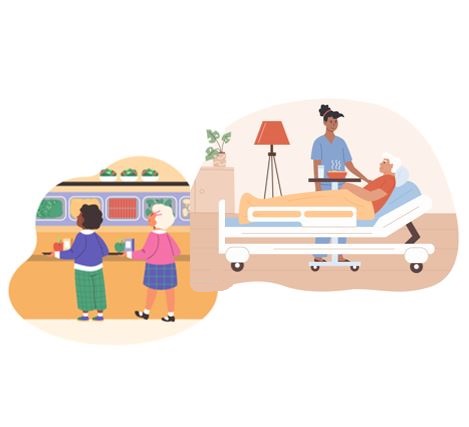
Who are society’s most vulnerable? It’s those who depend on others for their care, the young and the sick. And there are nutrition professionals paid to feed them through our institutions. Would you agree they have a great responsibility, and that we should trust they have all of the best information and resources to support those in their care? But it’s not that simple. And what I’ve learned has frustrated me. So today I’m going to fill you in on what I’ve learned. If you have kids in school or loved ones in hospital, today’s post should perk your ears.
The What
Institutions that feed our children and our sick are a huge part of our food system. So I would be remiss if I didn’t explore them a little in this blog.
The Why
This is a huge equity issue. Read below for stories that exemplify how the system is not where it could be.
Just the Facts Ma’am
Stories are powerful. So, this week, I’ll share two stories. What they say to me is that institutions have room for improvement. They also show how those with the means have the ability to work above and around the system, while others just can’t and that’s a real problem.
A Hospital Food System Story
A friend of mine is a physical trainer and nutritionist. His partner, with his input, provides healthy prepared meals as a business. They have a client in his early 70s who has esophageal cancer. He was going in for surgery to remove the cancer and part of his digestive tract. The doctor told him he would have to be on a liquid diet for weeks after the surgery while his system healed. The doctor handed him a “meal replacement” drink made by Nestle. The drink is fortified with vitamins and protein, and provides quick energy; however, the first two ingredients are water and maltodextrin. Maltodextrin spikes your blood sugar more than table sugar. It has no fiber because it is ultra-processed. And it is suspected to kill the good bacteria and feed the bad in your gut microbiome. So, Andrew’s client hands him the drink and says, “I’m not drinking that. I want you guys to help me with my nutrition after my surgery.”
Public School System Story
I was in my children’s elementary school. We live in area of town considered affluent, a mix of upper middle to upper income families. Our district has what’s called School of Choice, which means we can bus kids in from different areas of the city. It also means we have kids on food assistance. I recently stopped by the school and saw a group of kids walk by carrying meals supplied by the district. Their foam plate had an apple, chocolate milk, and a package of Eggo pancakes. I was pleased to see the fresh fruit, but also dismayed to see the processed, high-sugar packages along with it. When I put money in my children’s school account, they opt for the chocolate milk and goldfish crackers provided by the school because they know they won’t get those from me. I’ve learned and I’m no longer funding their accounts. But I’m also able to provide for my children’s nutritional needs.
I decided to reach out to Chartwells, the company that is contracted to supply our schools with food. Their response was that they had to feed the kids what they are willing to eat and they follow the USDA guidelines. The American Heart Association is actually recommending changes to the USDA guidelines to be more heart-healthy. So, that’s a non-answer, in my book. While I’m sure there are a lots of constraints and challenges with any job, I was disappointed by Chartwell’s response. Sure, if you ask my kid if she would rather have plain milk or chocolate milk to drink, she’ll choose the chocolate. If she can munch on carrots or goldfish, she’ll typically go for the goldfish. But when the less healthy options aren’t there, she drinks the plain milk and eats the carrots. So why are we providing kids with less healthy options to begin with? And for those who rely on this program for food security, is it fair that they are subject to potential struggles with sluggishness, irritability or emotional regulation that can be caused by food high in sugar, while their classmates may not? And that is just the short-term effects of processed, high-sugar foods. We live in a country with high rates of childhood type 2 diabetes and other diet-related chronic health issues, including those related to behavior and emotional regulation. More and more evidence is out there that poor diet impacts mental health and acuity.
Let’s Jump Down the Rabbit Hole, Shall We?
Institutions like hospitals, schools and government organizations are often responsible for feeding people. Some operate on antiquated information – like low fat is always better, and changing policies can be like turning a large ship, i.e. slow and cumbersome. Some just do the bare minimum because the government doesn’t set strict enough dietary guidelines to ensure long term health. For example, the USDA recommended dietary guidelines for added sugar is 10% or less of daily calories. So many of the organizations that feed children and the healing adhere to that bare minimum. And since sugar is not the only food ingredient that behaves like sugar in our bodies (when ground into flours, most grains act like sugar in the body, triggering weight gain, inflammation and blood-sugar imbalances) the impact is compounded. Imagine our children and our sick being fed foods, while they try to grow and heal, that create this kind of havoc in their bodies. I’d like to propose that despite budget constraints and the appeal of longer shelf life for many of these food choices in our school systems, the status quo is just not good enough.
To add insult to injury, food companies often act like pharmaceutical companies might. For example, a doctor’s office will often receive a free case of Ensure, meal replacement shakes, with coupons, so that doctors can hand out samples and a coupon. The result is Ensure gets new customers, and it appears to be doctor-approved. It’s no different in the schools. If consumer packaged goods (CPG) companies, like Kellogg for example, can put their products in the hands of children, they are likely to get customers for life. According to a recent article in the Washington Post, “How Lunchables Ended Up on School Lunch Trays“, “While many nations have adopted more-nutritious school meals and stricter advertising standards, pizza sauce and french fries still count as vegetables for schoolchildren in the United States, and U.S. food companies remain virtually free to advertise to youngsters any way they like.”
There’s a ray of hope in this journey, however. According to an article in Farm Progress, the USDA just announced that it is partnering with the Urban School Food Alliance, one of the countless (we should ask why there are so many to begin with) organizations trying to make school lunches healthier “to meet goals established during the September 2022 White House Conference on Hunger, Nutrition and Health. [Agriculture Secretary Tom] Vilsack believes it’s important to work with school districts to identify best practices and develop better school menus.” And there is grant money provided by the USDA that can be awarded to school programs looking “to developing and implementing new tools to push for a more efficient and sustainable food system that includes supporting local economies.” Seems like a push-and-pull scenario unfolding here…
Trinity Hospital near me has an organic farm on-site. The only problem is the food grown there doesn’t go to the patients. It goes to hospital workers and local food banks. That’s wonderful, but aren’t we missing a key population here??
There’s always more to it. I don’t live or work within the system, so until you walk a mile in their shoes, right? And recently a nutritionist told me, “They are still getting calcium and protein and calories for energy.” But my question about emotional and behavioral health of school children eating this food, and the one about negative long-term health effects that come from the added sugars, ultra-processed grains and added chemicals? What about the negative inflammatory effects of the processed foods and sugars on healing bodies? No one has an answer for me yet. And if you look at the rate of food-related chronic illnesses in our country, according to the FDA more than a million Americans die from diet-related diseases each year, it can’t be a surprise that we are not where we should be. I’m at least grateful there are those that are fighting to improve our systems.
I think the correct way to frame the questions surrounding this issue might be this:
- How can we feed our sick, our needy, and our young in a way that not only sustains them, but contributes to their thriving?
- How much money will it take?
- What kind of additional policy change needs to happen?
- To what extent do we offer empathy and gratitude to those in the trenches on a daily basis?
- To whom can we say “thanks, but that’s not enough”?
What you can do
- Read Digestible’s upcoming posts where we’ll dive into the WHY a bit more. I don’t like the idea that I might be demonizing well-meaning people, or ignoring what’s already being done. So I plan to find out more – stay tuned.
- Watch movies like That Sugar Film or Fed Up to learn more about this issue.
- Find out how to change policy and where. Example: The county I live in has a Food Policy Council, whose meetings are open to the public. I went to one, and plan to attend more. Attend a school board meeting. Listen and ask questions.
- Talk to your state reps. Find out who represents your district in the state house and senate. They vote on a budget every year. The more they hear about policy concerns surrounding this issue, the more likely they will learn/act/fund. In Michigan, for example, the state voted to fund, in this year’s budget, school meals for every student, regardless of need, to address hunger and remove shame. (If all students are being fed, no student needs to feel shame for receiving a no-cost meal). That happens because people spoke up, and the legislators listened.
One response to “The Institutions That Feed Us”
Melissa, I agree with you 1000%. Thanks for making the call and starting to plant the seed in the school and hospital organizations that feed our children and our sick. This is so important for people to be aware of. You are an incredible resource! Please keep sharing the knowledge!